
Summary
- Wells Fargo's stock price has declined materially during the Covid-19 correction.
- The historical volatility and implied volatility of the stock are at peak levels.
- The Coronavirus has slashed the current EPS, but in the long-run, the earnings will normalize again.
- Options offer the possibility to get paid for the high volatility, without actually owning the stock.
Wells Fargo & Company (WFC) is currently going through volatile times in 2020. The stock started the year around the $50-$55 level (after a modest gain over 2019), only to lose over 50% as the Coronavirus struck the markets.
The stock price finally started to gain momentum after mid-May, after lagging the stock market in general. Most recently, the stock has again lost again 20% in only 3 trading days.
Source: Wells Fargo corporate website
The erratic stock price movements have caused the underlying volatility of Wells Fargo to spike to historical peak levels. This spike in volatility creates opportunities for options traders which we will discuss in this article.
We will start with a brief look at the historical price performance of WFC, the impact of the Coronavirus, and conclude the article with a trading proposal which demonstrates how one can benefit from the peak volatility in the stock price.
Historical Performance
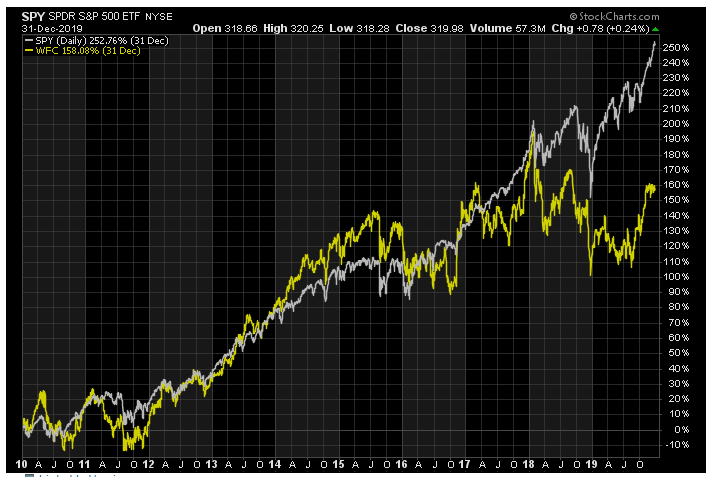
When we look at the performance of Wells Fargo over the past decade we can see the stock has tracked the performance on the S&P 500 index (SPY) over the period 2010-2018. Only in the last two years (2018-2019), the stock started to underperform the market index.
Source: stockcharts.com
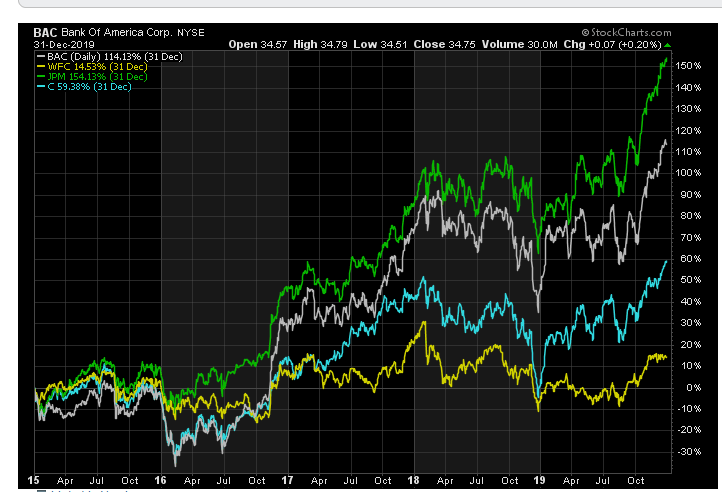
By comparing the stock performance of Wells Fargo with the performance of the other 3 major US banks (Citigroup Inc. (C), JPMorgan Chase & Co. (JPM), Bank of America Corporation (BAC)), we can see Wells Fargo has been the worst-performing major US bank.
Source: stockcharts.com
The reason for the underperformance of Wells Fargo can be linked to the fake account scandal, which caused investors to sell the stock. The company had a hard time attracting new investors in the aftermath of the scandal and the stock mostly consolidated around $50-$60 zone, while other banking stocks were making new highs.

