
Summary
- The financial sector has been declining rapidly as the broader coronavirus and oil shocks to the market create credit, lending, and yield curve worries for banks.
- Wells Fargo, already facing turbulent ups and downs due in part to variety of regulatory limits, has declined at a faster pace than many of its banking peers.
- Regulatory risk to Wells Fargo appears to be materially minor at the moment, even if there is a lot of huffing and puffing still going on.
- Governments likely will look to prop up the market and financial market as a whole over targeting Wells Fargo specifically as the current market and economic turmoil continues.
- The bank's current price point is a very attractive entry for long-term investors - although there may well be more volatility still ahead.
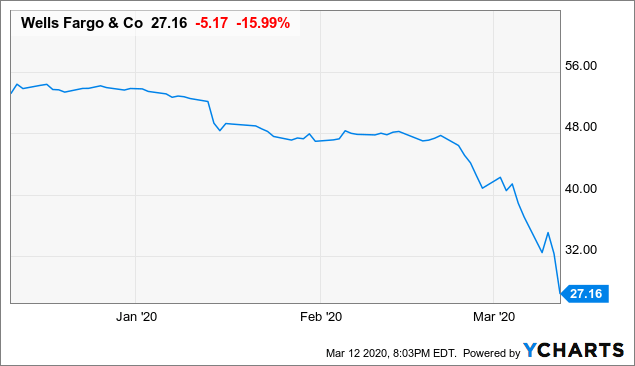
Amid a financial sector (XLF) whose equities have been collapsing with shocking speed, Wells Fargo (WFC) stands out as a bank that has sold off faster than its peers for no discernible sensible reason. Wells Fargo is a bank that has been plagued by regulatory problems for years, but the current selloff seems overdone.
Currently, given the current historically volatile market environment means declines and turbulence may still continue for some time, Wells Fargo seems to be at an attractive entry point for a long-run investor to a generally seemingly healthy financial institution likely to survive the current and immediate future economic turmoil.
 Data by YCharts
A Financial Sector Annihilation Where Wells Fargo Is Particularly Burned
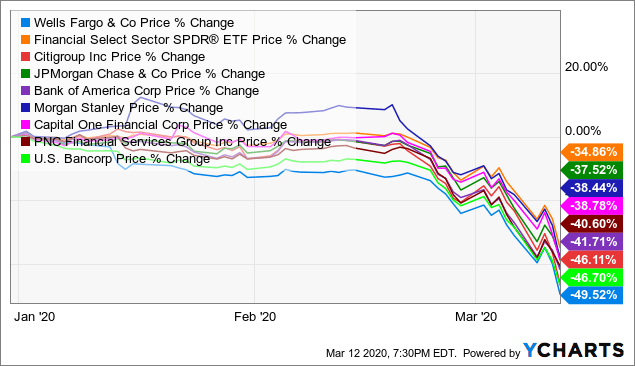
As shown in the chart below, Wells Fargo is comparatively oversold relative to other similar banking peers and the banking-oriented financial services sector as a whole.
 Data by YCharts
Past Sins Still Haunt Wells Fargo, But Most Of Its Risk Is Gone
A potential reason why Wells Fargo faces greater investor hesitation as compared to other major U.S. banks is because it is still the subject of continuing regulatory concern. In Wells Fargo's seemingly frequent game of musical leadership chairs nowadays, the bank's Chair Betsy Duke resigned a few days ago after the Chair of the House Financial Services Committee called for her ouster.
CEO Charlie Scharf spent the immediate aftermath, while its share price tanked amid the broader market losses of the week, doing a mea culpa of hearings before the House Financial Services Committee amid government reports that its corporate governance since its historic 2018 Federal Reserve asset-limitation hasn't improved much. The Federal Reserve's consent order was due to the multi-year fake accounts scandal, among other poor and deceptive practices, that resulted in the bank spiraling into the public spotlight as a "bad bank" for public scapegoating.

